 Dossier
 Margin
Dossier · 25 November 2026 · Claude Code 2.1.332
Code Mode cuts the count more than the bill, except on MCP-heavy work
Claude Code is an AI helper that writes and changes code. Its new Code Mode lets it plan a whole errand at once instead of one trip at a time. Testers found it reads far fewer words, and usually saves less money than that suggests, except on jobs that fetch lots of records from other programs, where the money and the time fell about as far as the words. Checked on 25 November 2026.
Claude Code’s new Code Mode has Claude write one script that calls many tools. Independent tests show big drops in tokens processed and smaller ones in dollars, except on jobs that make many MCP calls, where the largest benchmark found the bill and the wait fell about as far as the count. Read as at 25 November 2026, Claude Code 2.1.332.
Code Mode routes Claude Code’s tool calls through one model-written JavaScript program run by the REPL tool. Outside MCP-heavy work, nine paired measurements show cost falling by less than the token reduction or rising; on 120-record MCP tasks, Bicameral’s 96-run benchmark shows cost and wall time falling about as far as tokens. State as at Claude Code 2.1.332, 25 November 2026.
In short
Inferred Verdict on 25 Nov 2026: on for big jobs, especially ones that fetch lots of records, off for small questions, and not possible at all if your computer talks to Claude through a middle-man.123456
Inferred Verdict as at 25 Nov 2026: on for long jobs in auto mode, above all MCP-heavy ones, off for quick questions, and not available at all if you route Claude Code through a proxy.123456
Inferred Verdict as at 25 Nov 2026, 2.1.332: enable for long multi-call sessions in auto mode with ask rules on sensitive commands, with the strongest case on MCP chains returning aggregates; leave off for short sessions; unavailable through a gateway or local proxy.123456
Code Mode is worth switching on for big jobs that fetch lots of records from other programs: there the money and the time saved kept up with the words saved. For jobs on your own files and for small questions, expect fewer words read, less money saved than that, and a slower run.147
Code Mode pays off most on jobs that make many MCP calls and need back only a total or a short list: there the bill and the wait fell about as far as the token count. On file work and small jobs, expect fewer tokens, a bill that falls less or rises, and a slower run.147
On multi-call jobs Code Mode reduces tokens processed by 35–77%. On MCP aggregation and triage, recorded cost fell 60–76% and wall time 27–77% (Bicameral, n=2 per cell); on file work and a control task, cost fell by less than tokens or rose, and every pair ran slower.147
- On big jobs, testers counted roughly a third to three quarters fewer words read by the AI.81
- The bill usually fell by less than that, and sometimes went up; the exception was fetching 120 records, where three quarters fewer words meant a bill three quarters smaller.41
- Whether it’s quicker depends on the job: in the biggest test, every record-fetching job got faster and every file job got slower.19
- The safety check reads the plan once before it starts, and can’t see what the plan picks up along the way.5
- It refuses to work through a middle-man connection, which is why it never ran on my computer.610
- On big multi-call jobs, testers counted 35% to 77% fewer tokens.81
- The bill fell by less, or rose, in eight of nine paired tests; the exception was 120 MCP fetches, where 77% fewer tokens meant 76% lower cost.41
- Speed splits by work: in the largest benchmark every MCP task ran faster and every file task ran slower.19
- The safety check reads each script once, before it runs, and doesn’t see what the script finds along the way.5
- It won’t start behind a gateway or local proxy, which is why it never ran on my machine.610
- Tokens processed: 465,875 → 291,471 (bolyki, 2 runs a side, averaged), 2.3M → 660k read (Chase AI), 740,000 → 176,530 (Pentiminax), 1.51M → 0.35M (Bicameral, Opus, M1, 2 runs summed).81
- Cost versus tokens in nine paired tests: −37% tokens → −19% cost; −35% → ≈−17%; −28% → +11% and −29% → +27% (Bicameral T1, C0); −77% → −76% on 120 MCP fetches.41
- Wall time: every Bicameral MCP pair faster (−27% to −77%), every file and control pair slower (+2% to +149%); 12 other comparisons from 7 testers split 5 faster, 6 slower, 1 level.19
- Auto mode’s classifier reviews each REPL script once before execution and does not see run-time values; rules and PreToolUse hooks still evaluate every nested call.5
- Provider check: a custom ANTHROPIC_BASE_URL or gateway disqualifies Code Mode; on one machine with the flag set, 0 REPL calls in 4,687 session logs.610
What would change this: bigger, more careful tests on everyday file jobs. The biggest test so far ran each job only twice, with made-up records.1
What would change this: a benchmark on file work with more than two runs a side and a cost breakdown by token class. The largest one so far ran two of each, on made-up tickets and a small MCP server.1
What would change this: a file-work benchmark at five or more runs a side with a per-token-class cost breakdown. Bicameral is the largest so far at n=2 per cell, on generated tickets, a two-tool MCP server and no subagents, with costs as Claude Code recorded them.1
Below: where the famous big numbers really came from, what testers saw, how the safety check changes, and when to switch it on.
The page walks through where the famous numbers came from, what testers measured, what moves in the safety model, and when to turn it on.
Sections below: provenance of the circulating figures, the token/cost gap, the latency split, edit visibility, the permission model, the provider refusal and the local audit, implementation lineage, release churn, and conditional verdicts.
The giant numbers you’ve seen are about something else
The big numbers going around are about something else
The circulating 98.7% and 99% figures measure a different mechanism
You might see claims that this kind of thing saves 98% or 99% of the words an AI reads. Those numbers are real, but they come from other companies’ systems, measured on a different job. Anthropic, the company that makes Claude, gives no saving number for Code Mode at all.1112135 Two people who checked, Duncan Rogoff and Nhan Tran, found the numbers had been borrowed; Tran found the same “37%” figure coming from three different places.1415
Scientists have tested the idea too, and found big savings, but on other AI helpers and with pretend tools that answer instantly. None of them tested Claude Code.1617
When it launched, Addy Osmani wrote that it “can improve both speed and context efficiency”.18 A month before Code Mode came out, one of Anthropic’s own engineers wrote that it’s “just a different way of doing tool calling” and “not a lot more token efficient from what I’ve seen”. That was a passing comment, not a test.19
The 98.7% and 99% figures you’ll see quoted are real measurements of other systems: Anthropic’s 2025 post on agents loading MCP tool definitions through code, Cloudflare’s Code Mode, and Bifrost’s benchmarks. Anthropic’s own Code Mode docs don’t give a saving number at all.1112135 Duncan Rogoff and Nhan Tran both caught the swap; Tran counted three different “37%” figures attached to the feature, from three different places.1415
Controlled studies of the pattern point the same way and carry the same caveat. A pre-registered study cut tokens by 70 to 90 percent, but with instant synthetic tools and three open-weight models; a 14-model comparison found code calls matching or beating ordinary tool calls in 11 of the 14. Neither measured Claude Code, or what anything cost.1617
The launch pitch, in Addy Osmani’s post, is that Code Mode “can improve both speed and context efficiency”.18 It’s worth holding next to what an Anthropic engineer wrote a month before launch: code mode “is just a different way of doing tool calling? not a lot more token efficient from what I’ve seen”. That’s a remark, not a measurement, and it predates Claude Code’s own version.19
Anthropic’s November 2025 post reports 150,000 → 2,000 tokens (98.7%) for an agent that discovers MCP tool definitions through a filesystem rather than loading them all; Cloudflare’s Code Mode fits 2,500+ API endpoints into about 1,000 tokens of schema; Bifrost reports 58.2–92.8% fewer input tokens across 96–500 tools. All three measure tool-definition loading in other systems. Claude Code’s Code Mode docs publish no savings figure.1112135 Rogoff flagged the substitution on video; Nhan Tran traced three separate “37%” figures to Anthropic’s programmatic tool calling post (43,588 → 27,297), Juan Andrés Núñez (150,364 → 94,659, one run a side) and bolyki.1415
Controlled evidence on other harnesses: Rai (arXiv 2611.19123, 14 November, preregistered, sealed split of 119 instances) reports code mode cutting tokens 70 to 90 percent against plain MCP on a synthetic gateway with 12 servers and up to 1,958 distractor tools, on Qwen, Gemma and Nemotron, and names the absence of real servers and real per-call latency as the largest threat to validity. Patel et al. (arXiv 2608.06370) find programmatic tool calling matching or beating JSON calls in 11 of 14 models on BFCL v4. Both are preprints; neither measures Claude Code or prices cache reads.1617
The launch claim (Addy Osmani, 21 November): Code Mode “can improve both speed and context efficiency when Claude needs to orchestrate multiple steps”. That’s a claim of possibility rather than a figure.18 For calibration: @trq212, an Anthropic engineer, on 17 October: “code mode is just a different way of doing tool calling? not a lot more token efficient from what I’ve seen”. It’s a remark rather than a measurement, made before Claude Code’s implementation shipped.19
| Figure | Origin | What it measured |
|---|---|---|
| 98.7% | Anthropic, Nov 2025 | an agent loading MCP tool definitions through code: 150,000 → 2,000 tokens11 |
| ≈99% | Cloudflare, Sep 2025 | 2,500+ API endpoints described in about 1,000 tokens12 |
| 58–93% | Bifrost docs | input tokens across 96 to 500 MCP tools13 |
| 37% | three separate sources | one API feature post and two practitioners' runs15 |
| none | Claude Code docs | no savings figure published for Code Mode5 |
The word count falls a long way. The bill only keeps up on record-fetching jobs.
The token count falls a long way. The bill keeps up only on MCP work.
Token reduction is 35–77%; cost keeps pace only on MCP aggregation
Think of the AI as a helper running errands. Normally it makes one trip, comes back, reads its whole notebook again, and goes out on the next trip. With Code Mode it writes one shopping list and does every stop in one go, bringing back only what it needs. Fewer trips means less rereading. AI companies count reading in tokens, which are chunks of words; I’ll just call them words here. On big jobs, testers counted roughly a third to three quarters fewer words read. One tester, over eight runs, went from about 466,000 words to 291,000; another from 2.3 million to 660,000.420218 Most people only tried each job one to three times.
The money saved was usually smaller than the words saved. A bit over a third fewer words came out about a fifth cheaper for one tester, and about a sixth cheaper for another. On one tiny job, the AI read about a fifth fewer words and the bill went up by about a fifth.4722 One test team found the cost came out the same; another found it a bit cheaper in four jobs out of five.223
The biggest test so far, by a group called Bicameral, ran 96 jobs and found the answer depends on the job. When the AI had to fetch 120 records one at a time from another program and add them up, the bill shrank about as much as the words did, by around two thirds to three quarters. When it worked on files, or answered one quick question, it read fewer words but the bill went up more often than it went down.1
One tester saw part of why. His run read about half as many words, but Code Mode’s first step had to store a fresh copy of its instructions, and that cost about as much as the rereading saved.24
Inferred Why the gap on file jobs? This part is my guess from what the testers said, not something anyone measured. The words the AI stops rereading are pages it had already bookmarked, and bookmarked pages cost only a small slice of the normal price. So cutting them shrinks the count a lot and the bill a little. Writing the shopping list costs a bit too, because the words the AI writes cost more than the words it reads. And storing that fresh copy of the instructions is a cost a short job never earns back.72532624
The same test found two things to watch. When the shopping list decides what the AI gets to read, it can leave things out: in one run, a list that searched for keywords missed four of the nine records that mattered.1 And the other program still gets asked for every record, so it doesn’t make less work for that program.
On jobs with many tool calls, independent on/off tests found 35% to 77% fewer tokens processed. George (@bolyki), over eight Sonnet 5.5 runs, went from 465,875 to 291,471 on a 1,662-file repo; Chase AI from 2.3 million to 660,000 on a Django change; Pentiminax from 740,000 to 176,530 fetching 120 tickets over MCP.420218 Most of these are one to three runs a side, on different tasks and models.
The dollar figure mostly didn’t keep pace. 37% fewer tokens became 19% lower cost for George, 35% became about 17% for Nate Herk, and roughly half became 29% for Ray Amjad. On George’s tiny task, 19% fewer tokens cost 21% more.4722 Better Stack found it about 80% faster with 28% fewer round trips, and the cost “came out to be the same”; Andres (@AndresMuelasT) found it 13% to 39% cheaper in four of five tasks.223
The biggest test so far splits that picture by kind of work. Bicameral ran six tasks twice each way on four models, 96 runs on 2.1.326, and read every number from the saved transcripts. On the three MCP tasks, which fetch 120 support tickets one call at a time, the bill fell about as far as the count: on the three models whose costs are big enough to compare, cost fell 60% to 76% while tokens fell 49% to 77%. On file work and a one-question control, tokens fell in all nine pairs and recorded cost rose in six.1 Those are Claude Code’s own cost figures, two runs a cell, on made-up tickets and a two-tool server, so I’d read them as a direction rather than a rate.
One paired run shows part of why. Arindam Majumder’s run nearly halved the tokens read, 264k to 140k, but the first Code Mode request wrote 33k tokens to a cold cache, and Claude Code put the two runs at $0.34 and $0.35.24
Inferred My reading of the file-work gap, and it’s an inference rather than a measurement, has three parts. The tokens Code Mode removes are mostly rereads of context already in the prompt cache, which bill at a fraction of fresh input. The script itself is written in output tokens, which cost more; one tester saw up to 1.5 times the output. And each new Code Mode prompt has to be written to the cache once, which a short job never earns back. Herk, the ejklock benchmarks and the Gemini report reason the same way about the first two.72532624
Two more things are worth knowing. How big a session starts depends on the setup: JeredBlu’s Code Mode session started at 29.7k tokens against 19.6k without, while Bicameral’s, with a two-tool MCP server, started about 13,000 smaller on every model, because Claude Code sends far fewer built-in tool definitions.271 And the model comparison Pentiminax quoted turns out to be Bicameral’s file-work row: 37% fewer tokens on Opus, 54% on Sonnet and 9% more on Haiku. Bicameral puts Haiku’s rise down to one run whose script looked in the wrong folder and failed 344 of 349 shell commands; Mario Zechner’s view that small models aren’t good at code mode yet fits that, but one run doesn’t prove it.828
Two cautions from the same benchmark. A script that decides what the model reads can drop records: in one run a keyword filter left four of nine tickets out of the answer, and on an earlier version another hid two of nine while the answer said every ticket had been read.1 And it doesn’t lighten the load on your MCP servers: the ticket server got the same 3 list calls and 120 fetches in every run, on or off.
On-off token counts for multi-call tasks: bolyki 465,875 → 291,471 (−37%, 1,662-file repo, two runs a side averaged, eight Sonnet 5.5 sessions in all per InfoQ); Chase AI 2.3M → 660k tokens read (−71%, Django feature) with final context 77k against 112k; Pentiminax 740,000 → 176,530 (−76.2%, retrieving 120 tickets over MCP); Herk −35% input across five comparisons; Software Engineer Meets AI −40% input.42021873 Counts include cache reads; tasks and models differ; n is 1–3 per side throughout.
Paired cost results, each tester’s own estimate: bolyki −37% tokens → −19% cost; Herk −35% → ≈−17% once weighted by price; Amjad ≈−50% input → 71% of baseline cost; the Zenn tester via Tran −58% → −16% and −59% → −20%; bolyki’s small task −19% tokens → +21% cost.415722 Better Stack (three runs a side) measured ≈80% faster and 28% fewer round trips with cost “the same”; @AndresMuelasT reports 13–39% cheaper in 4 of 5 tasks on Opus 5.5 at 2–3 runs each.223
Bicameral (17 November, Claude Code 2.1.326, medium effort, auto permissions, fresh session per run, macOS): six tasks × two modes × two runs × four models = 96 runs, 93 passing, every figure read from the saved transcripts. Recorded cost and tokens processed, two runs summed, Opus 5.5: M1 (total refunds across 120 MCP tickets) 1.51M → 0.35M tokens and $1.74 → $0.41; T1 (broken links in 47 files) 657k → 473k and $0.65 → $0.72; C0 (one-question control) 176k → 124k and $0.33 → $0.42. Across Opus, Sonnet and Fable, the MCP tasks M1–M3 cost 60–76% less as tokens fell 49–77%; on T1, E1 and C0, tokens fell in 9 of 9 pairs and recorded cost rose in 6. Haiku’s costs are a cent or two a run and too coarse to compare.1 The cost column is Claude Code’s own recorded figure, not checked against a price list; the server exposed two tools, and no run used subagents.
Majumder (21 November, 2.1.330, one paired run): tokens read 264k → 140k, requests 5 → 4, Claude Code’s cost estimate $0.34 → $0.35, attributed to the first Code Mode request writing 33k tokens to a cold cache.24
Inferred Inferred, not measured: three mechanisms for the file-work gap. The removed tokens are mostly per-turn rereads of the cached prefix, billed as cache reads at a fraction of input price, so fewer turns cut processed tokens far more than spend; the script is generated as output tokens, billed higher, which Software Engineer Meets AI saw rise to 1.5×; and Code Mode’s different prompt has to be written to the cache once, a fixed cost a short job never recovers. The C0 control, where tokens fell 29% on every model and recorded cost rose 27–36% on the three comparable ones, fits the third. No tester published counts split by input, cache-read, cache-write and output.72532624
Starting size depends on setup. JeredBlu’s Code Mode session opened at 29.7k context tokens against 19.6k without, measured before 2.1.328 shortened Code Mode’s tool descriptions; Bicameral’s, with a two-tool MCP server, opened about 13,000 tokens smaller on every model on 2.1.326, because built-in tool definitions fall from 16.3k to 3.6k tokens.271 The model split Pentiminax quoted (−37% Opus, −54% Sonnet, +9% Haiku) is Bicameral’s file-work tokens-processed row; Bicameral attributes Haiku’s +9% to one run in which 344 of 349 shell commands failed, and of Haiku’s other three file pairs two used fewer tokens and one 16% more. Zechner, Pi’s author: “smol models aren’t great at codemode at all yet. frontier models love it.”828
Accuracy and server load: on the triage tasks, one Haiku run’s keyword filter missed 4 of 9 qualifying tickets, and on 2.1.325 another hid 2 of 9 while reporting every ticket read.1 The MCP server received 3 list calls and 120 get_ticket fetches in every run in both modes, so Code Mode moves intermediate results out of the context without reducing backend requests.
Schedule A Nine tests where people measured both the words and the money. The counted line is how much the word count fell; the charged line is how much the bill fell. The charged line is shorter, or goes the wrong way, every time except the record-fetching job at the top, where the two are about level.4157221
Schedule A Counted against charged, in nine paired tests from five sources, three of them Bicameral’s Opus runs. The counted rule is the change in tokens processed; the charged rule is the change in cost. The charged rule is shorter, or points the other way, in eight rows; on 120 MCP fetches the two are level.4157221
Schedule A Change in tokens processed (counted rule) against change in estimated or recorded cost (charged rule), nine paired tests from five sources, three of them Bicameral Opus cells (two runs summed), common axis −100% to +30% (−80% on narrow screens) with zero marked. |cost| < |tokens| or a sign change in eight rows; level within a point on M1.4157221
Schedule A as a table
| Paired test | Tokens | Cost | Origin |
|---|---|---|---|
| Bicameral, 120 tickets over MCP (Opus) | −77% | −76% | two runs a side, summed · 2.1.326 |
| Zenn tester, one typo fix | −59% | −20% | via Nhan Tran · one run a side |
| Zenn tester, link check | −58% | −16% | via Nhan Tran · one run a side |
| Ray Amjad, real open-source issues | −50% | ≈−29% | his own agent's runs · input tokens |
| George (@bolyki), 1,662-file repo | −37% | −19% | two runs a side, averaged |
| Nate Herk, five tasks pooled | −35% | ≈−17% | input tokens · cost weighted by price |
| Bicameral, one-question control (Opus) | −29% | +27% | two runs a side, summed · 2.1.326 |
| Bicameral, broken links in 47 files (Opus) | −28% | +11% | two runs a side, summed · 2.1.326 |
| George (@bolyki), small task | −19% | +21% | two runs a side, averaged |
Whether it’s quicker depends on the job
Speed splits by kind of work: faster on MCP jobs, slower on file work
Latency splits by workload: MCP tasks faster, file and control tasks slower
Seven people timed twelve jobs with Code Mode on and off. It was faster five times, slower six times, and the same once. At best it took less than half the time (35 seconds down to 15). At worst it took nearly seven times as long (three minutes instead of 27 seconds).29921277 Most of those were run only once, and the same job can take 12 seconds one time and 36 the next, so no single result proves much.
The biggest test makes it clearer. Every job that fetched lots of records got faster, some taking a quarter of the time. Every job on files, and the one quick question, got slower.1
Two people have reported bugs that make some jobs slower. In one, a step meant to run after a long command never happens, so Claude does the whole thing again. In the other, Claude sits and waits for slow jobs instead of getting on with something else. Anthropic hasn’t answered either yet.3031
Small jobs are where it clearly loses. Writing the shopping list takes time, and for a quick errand that’s wasted effort: one tester saw a run take more than five times as long. Anthropic says to use it for jobs like changing many files at once.35
Across 12 timed on/off comparisons from 7 testers, Code Mode was faster in 5, slower in 6 and level in 1. The spread runs from 2.3 times faster (Flavio Copes’s link check, 35 seconds down to 15) to 6.7 times slower (Nate Herk’s broken-links job, three minutes against 27 seconds).29921277 Most of those are single runs, and one of Herk’s runs with it off took 12 seconds once and 36 seconds the next, so treat any single row as noise.
The largest benchmark splits it cleanly. In Bicameral’s 24 model-task pairs every MCP task ran faster, by 27% to 77%, and every file and control task ran slower, some by only 2%. On Opus, totalling the 120 tickets went from 142 seconds to 35, and the broken-links job from 84 seconds to 179.1
Two open bug reports explain some of the slow runs. Steps chained after a command sent to the background never run, so Claude reruns the command and the job takes twice as long; and Claude waits out 20-minute CI runs with sleep loops inside its scripts, ten minutes at a time. Neither has a reply from Anthropic yet.3031
Small jobs are where it loses most clearly. One tester measured a run more than five times longer with 1.5 times the output tokens, and Anthropic’s docs point it at changes across many files, filtered searches and parallel commands rather than quick questions.35
Seconds, off → on: Flavio Copes link check 35 → 15 and build+tsc+npm outdated 17 → 14; José Antonio Garrido MCP task 21 → 21; bolyki 1,662-file repo 27.9 → 32.2 and small task 12.3 → 18.2; Juan Andrés Núñez 40 JSON files 15 → 37; Chase AI docstring count 25 → 21, small task 11 → 15, Django ≈275 → ≈200; JeredBlu YouTube MCP 22 → 30 and OpenRouter MCP 44 → 39; Herk broken links 27 → ≈180.29921277 Ratios run from 0.43× to 6.7×. Most are single runs, and Herk’s own off-mode run varied from 12 s to 36 s on repetition, so the per-row variance is comparable to the effect.
Bicameral (two runs summed, four models): MCP tasks M1–M3 faster in 12 of 12 pairs, by 27% to 77%; file and control tasks T1, E1, C0 slower in 12 of 12, by 2% to 149%. Opus: M1 142 → 35 s, T1 84 → 179 s. The dots below are the other 12 comparisons; Bicameral’s are kept out of them because they are summed pairs, not single runs.1
Open reports bearing on the slow rows, unconfirmed by Anthropic: #111618 (2.1.327 and 2.1.330) has steps chained after a backgrounded shell command never running, so Claude reruns it in the foreground and wall time doubles; #112152 (filed 25 November) has Claude waiting on 20-minute CI with await sleep(420000) and poll loops, holding the session up to the ten-minute foreground limit per script.3031
Small tasks lose most consistently: Software Engineer Meets AI reports more than 5× wall time and up to 1.5× output tokens, which fits the cost of generating the script up front. The docs scope the feature to changes repeated across many files, searches needing filtering, and independent parallel commands.354
Schedule B Twelve timed tests. Dots left of the line were faster with Code Mode, dots on the right were slower. Five are left, six are right, one sits on the line.92921277
Schedule B Twelve timed comparisons, Code Mode on against off. Left of the line is faster, right is slower, on a log scale so twice as fast and twice as slow sit the same distance out. Five land left, six right, one on the line.92921277
Schedule B On/off wall-time ratio for 12 comparisons, log₂ axis centred on 1×; left is faster. Excluded for lack of absolute times: Better Stack (≈80% faster, 3 runs a side) and Software Engineer Meets AI (>5× slower).92921277
Schedule B as a table
| Comparison | Off (s) | On (s) | On ÷ off |
|---|---|---|---|
| Flavio Copes · broken-link check | 35 | 15 | 0.43× |
| Chase AI · Django JSON option | 275 | 200 | 0.73× |
| Flavio Copes · build, tsc, npm outdated | 17 | 14 | 0.82× |
| Chase AI · count undocumented functions | 25 | 21 | 0.84× |
| JeredBlu · OpenRouter MCP lookup | 44 | 39 | 0.89× |
| José Antonio Garrido · MCP task | 21 | 21 | 1.00× |
| George (@bolyki) · 1,662-file repo | 27.9 | 32.2 | 1.15× |
| JeredBlu · YouTube MCP question | 22 | 30 | 1.36× |
| Chase AI · small task | 11 | 15 | 1.36× |
| George (@bolyki) · small task | 12.3 | 18.2 | 1.48× |
| Juan Andrés Núñez · 40 JSON files | 15 | 37 | 2.47× |
| Nate Herk · broken-links job | 27 | 180 | 6.67× |
The AI was already making lists. Now you can see what it changed.
Claude was already scripting big jobs. Now you can see what the script changed.
Without Code Mode Opus scripted the edits anyway, outside Claude Code’s tools
Code Mode means Claude writes a small program in JavaScript, a common programming language, that does many steps at once and reports back only what matters. It’s an experiment, it’s switched off unless you turn it on, and it arrived on 12 November 2026.53233
The most interesting test wasn’t about words at all. Without Code Mode, Claude already wrote its own little program to change 53 files at once, but Claude Code couldn’t see what that program did; its record showed no changes. With Code Mode, every change went through Claude Code’s normal editing tool and showed up properly: 224 lines added and 171 removed.2 That’s one test, but it’s the result I’d care about most.
It can also keep working in the background for up to two hours while you chat with it, but only in the modes where you’ve let it act without asking. Otherwise it waits, and stops after ten minutes.529
The helper also remembers between lists: a note one program writes down is still there for the next one, until the session is closed and reopened.322
Code Mode has Claude write a piece of JavaScript that makes the tool calls and returns only what Claude needs to read. It’s experimental, off by default, and arrived in 2.1.323 on 12 November.53233
The most useful finding in the testing wasn’t about tokens. Without Code Mode, Opus already scripted a 53-file change itself in all three of Better Stack’s runs, through a Python script Claude Code couldn’t see; /cost reported zero lines changed. With Code Mode, the same edits went through Claude Code’s own Edit tool and showed as 224 lines added and 171 removed, each one a real diff.2 That’s one tester and one task, but it’s the part I’d weigh most.
The other change you’ll notice is background work: code can keep running for up to two hours while you keep talking to Claude, but only in auto or bypassPermissions mode. Otherwise Claude waits, and the code stops at ten minutes.529
Scripts also keep state between them: a variable one script sets is still there for the next, which is how Better Stack’s run loaded a 44 MB log once and kept asking it questions. A resume clears it.322
Mechanism, from the docs: Claude emits JavaScript to the REPL tool; the script calls tools as functions such as $ for shell and edit(), runs calls in parallel, threads results between them, and returns only its final expression to the model. The user sees the nested tool calls; the code is in the transcript viewer behind Ctrl+O. Experimental, off by default, first shipped in 2.1.323 on 12 November 2026, announced by @ClaudeDevs on 17 November.53233
Better Stack, 166 edits across 53 files: in all three off-mode runs Opus chose to write a Python script and run it through Bash, so /cost reported 0 lines added and 0 removed; in on-mode runs the edits went through Claude Code’s Edit tool, /cost reported 224 added and 171 removed, and file history tracked all 53 files. In one off-mode run the script crashed mid-way and auto mode blocked the git checkout recovery as destructive.2 One tester, one task; it’s the result I’d weight most, because it changes what review can see rather than what the bill says.
Background execution: in auto or bypassPermissions mode code can run up to two hours while the conversation continues; otherwise Claude waits and the script stops at ten minutes (time at a permission prompt stopped counting in 2.1.328). Flavio ran 101 shell commands from one block, 100 builds averaging 1.32 s, in 2 m 23 s while asking an unrelated question.529
State persists across REPL calls within a session: 2.1.329 fixed a script’s let x; inheriting an earlier script’s value, and 2.1.332 tells Claude on resume that earlier script variables are gone. Better Stack’s second test leaned on it, loading a 44 MB, 200,000-line log into a variable once and querying it repeatedly instead of re-parsing per call.322
The safety check reads the plan once, not each step
The safety check reads the plan once, not each step
Classifier review moves from each call to each script, and it can’t see run-time values
Claude Code has a safety checker that can stop risky actions. With Code Mode, it reads the whole shopping list once before the trip starts. It can’t see what the list picks up along the way. If the list says “find the old files, then delete them”, the checker never sees which files they turned out to be. Rules you’ve set for particular actions, like “always ask me before uploading”, still apply to every single step.534
The program itself runs outside the safety box that Claude Code puts around commands. Only the commands it starts go inside the box.535
It doesn’t change who’s allowed to do what, though. Someone who builds login and permission systems for AI helpers said it “doesn’t materially change anything” about those.20
People replying to the launch put it well: approving a plan instead of each step turns the safety prompt into reading code, and if the checks live inside the plan Claude wrote, Claude could quietly loosen them. Those are opinions, but I think they’re fair.33
In auto mode, the classifier reviews each piece of code once, before it runs, not each tool call inside it. It doesn’t see values the script computes along the way, such as a path it pulls out of search output. Your deny and ask rules and PreToolUse hooks still see every call under the tool’s usual name.534
The JavaScript itself, and its file, web and MCP calls, run outside Claude Code’s sandbox; only the shell commands it starts are sandboxed. Rhys Sullivan reports it runs in node:vm inside Claude Code’s own process.535
Two hook changes are worth knowing. Since 2.1.329, a PreToolUse hook that errors no longer refuses a script’s tool call, so a hook that must refuse needs "onFailure": "block". Since 2.1.328, UserPromptSubmit hooks no longer see code output; redaction belongs in a PostToolUse hook on REPL.325
Three gaps are reported and not yet answered. A script’s file() reads fire no Read event, so a hook that insists on a read before an edit blocks valid scripts; one user found that was the top cause of failed scripts in about 900 calls. And a PostToolUse redaction hook keeps only about 30,000 characters of output, which in Code Mode quietly cuts the data the script goes on to parse. And a mod’s hooks module never gets PostToolUse for a script’s output, so a mod can’t redact it.363738
What doesn’t move is the auth layer. An engineer who builds agent auth infrastructure told InfoQ that Code Mode “doesn’t materially change anything wrt authentication, authorization and audit policy layers”; the same MCP calls go out with the same tokens.20
The replies to the announcement put the concern plainly: the permission prompt “basically turns into a code review”, and if a check lives inside the script Claude just wrote, Claude can loosen it to get a pass. Those are opinions, but I think they’re the right ones.33
Auto mode decision order with Code Mode on: the code goes to the classifier once before it runs, and the nested calls don’t. Per the docs, the classifier “doesn’t see values computed at run time, such as a path taken from search output”. Deny and ask rules and PreToolUse hooks still match every nested call under its usual tool name (Bash, mcp__server__tool); Bash rules match command text, and a nested git push can arrive as cd 'app' && git push. A REPL-matching PreToolUse hook can read the script from tool_input.code.534
Sandbox scope: “The JavaScript itself and its file, web, and MCP tool calls run outside the sandbox”; only shell commands are sandboxed, and the docs recommend a container or VM to isolate the rest. Sullivan reports node:vm in process under Bun; the 2.1.332 binary bundles Bun’s node:vm with createContext and runInContext near the Code Mode code, but I didn’t trace the call path, so treat the runtime detail as corroborated rather than established.535
Hook semantics changed twice in a week. 2.1.329: a PreToolUse hook that errors no longer refuses a script’s tool call; command and http hooks need "onFailure": "block" to refuse on failure, and a timeout still refuses. 2.1.328: UserPromptSubmit hooks, managed ones included, no longer receive code output; redaction moves to a PostToolUse hook on REPL returning updatedToolOutput with the documented shape.325
Two open gaps, user-reported: #111575 says inner calls reach the transcript only when a script ends, so a transcript-reading PreToolUse hook can’t see an earlier tools.Read, and file(path).text() fires no Read event, “the top cause of failed scripts in about 900 REPL calls”; the tools reference documents no file() helper, so this is neither confirmed nor denied. #112065 (2.1.331) says updatedToolOutput keeps only about 30,000 characters and drops the spill path, so a Bash redaction hook truncates the data a script parses. #111259 (2.1.329) says a hooks module’s classic.PostToolUse never fires for REPL, so a mod can’t redact a script’s result while settings command hooks can.363738
Unchanged: authentication, authorisation and audit. Ravi Madabhushi, quoted by InfoQ on 23 November: it “doesn’t materially change anything wrt authentication, authorization and audit policy layers”; the nested MCP calls carry the same tokens and context.20
Two replies to the announcement state the design concern: “the permission prompt basically turns into a code review” (@jeffbruchado), and “If the check lives in the script Claude just wrote, what’s stopping it from loosening that check to get a pass?” (@world_0618). Opinion, not measurement.33
Schedule C Where each check sits. The safety checker reads the plan at the top; your rules sit on every step; the safety box only wraps the commands.5
Schedule C Where each check sits. The classifier reads the script once at the top; rules and hooks sit on every call; the sandbox wraps only the shell.5
Schedule C Check placement in a Code Mode session: classifier on the REPL input; rules and PreToolUse/PostToolUse hooks on each nested call; OS sandbox on shell commands only.5
It won’t work through a middle-man, and that’s how I found out
It won’t start behind a proxy, and that’s how this page found out
The provider check refuses gateways and proxies, which is why it never ran here
Some people connect Claude Code to Anthropic through a middle-man program on their own computer. Code Mode refuses to start when that happens. Anthropic’s instructions say so, and the program itself contains the message: “it isn’t offered yet through a gateway or proxy”.56
It also works when Claude Code runs from a script with no chat window, but again only when it talks to Anthropic directly.6325
On my computer Code Mode was switched on and never ran once. Across 4,687 records of Claude Code sessions in the two weeks since launch, it was used zero times.10
Inferred I think the middle-man on my computer is why, but that’s worked out from my settings, not read off a screen that says so.610
Four research tools finished reports for this page, and they disagreed. One said to switch Code Mode on through exactly that kind of middle-man. Two said not to switch it on everywhere until problems like that were sorted out. The fourth was me, in this same session, so it isn’t an independent opinion. Anthropic’s instructions and the program itself agree with the two that said wait.3926404156
Code Mode refuses to start through a gateway or proxy. The docs say so, and the 2.1.332 binary carries the refusal text: “it isn’t offered yet through a gateway or proxy, or with Claude for Government”. HTTPS_PROXY is fine; a custom ANTHROPIC_BASE_URL is what trips it.56
Headless runs are in now, on the same terms. The 2.1.332 binary says claude -p and Agent SDK apps get Code Mode only on the Anthropic API, not through a cloud provider or gateway, and two 2.1.332 fixes touch both, even though the docs page still describes an interactive terminal feature.6325
On my machine the flag was on and Code Mode never ran: 0 REPL calls across 4,687 session logs in the 14 days since launch.10
Inferred The likely cause, and this is inferred from the config and the binary rather than read from /status, is a local proxy at 127.0.0.1 set as ANTHROPIC_BASE_URL.610
The four research backends that returned for this page split on exactly this. Perplexity recommended turning Code Mode on by default behind a local proxy and called the runtime sandboxed. Gemini and OpenAI both said not to turn it on across a proxied setup, and OpenAI suggested a trial pinned to one version, kept apart from the proxy. The Claude lane, which I ran in this same session, expected the smaller, cost-discounted saving everywhere, and Bicameral’s MCP results say otherwise. The docs and the binary side with Gemini and OpenAI on the proxy.3926404156
Refusal reasons are a switch in the 2.1.332 binary (native build, 383,795,280 bytes, macOS 27.0 build 26A428, read with strings on 25 Nov 2026). The relevant case, verbatim: case"provider":return"it isn't offered yet through a gateway or proxy, or with Claude for Government". A neighbouring case refuses an API key helper, ANTHROPIC_AUTH_TOKEN or custom auth headers on the Anthropic API. The docs agree: HTTPS_PROXY is allowed, a gateway is not.56
Headless status, settled from the same switch: case"headless_provider":return"for now claude -p and Agent SDK apps get it only on the Anthropic API, not through a cloud provider or a gateway", and 2.1.332 carries two fixes for Code Mode in claude -p and the Agent SDK. The docs page’s surface list (interactive terminal only) and the Gemini report’s exclusion of -p both lag the 2.1.332 binary.6325
Local audit method: grep -l '"name":"REPL"' across every Claude Code .jsonl transcript modified in the 14 days to 25 Nov 2026, 4,687 files including subagent transcripts; 0 matched. The same pattern matched 46 Bash calls in the session that ran the audit, so the format is right.10
Inferred Inferred cause: CLAUDE_CODE_EXPERIMENTAL_CODE_MODE=1 is exported from the shell profile, and ANTHROPIC_BASE_URL is http://127.0.0.1:8858, a local proxy, which is the provider case above; the custom header present is not an auth header. I didn’t read /status, which prints the actual reason.610
The backends split. Perplexity Sonar Deep Research (run dr_79c2b59543276ae4, 19 citations, 19 of 19 resolving) recommended enabling Code Mode “by default” behind a local proxy, called the runtime a “sandboxed REPL”, and marked the ejklock benchmark table as missing data although it’s in the README. Gemini Deep Research, run by hand after the Dossier lane failed to start, recommended against global activation until three blockers were resolved: the proxy, hook semantics, and code mode nested inside a router’s code tool. OpenAI gpt-6.1-sol through the Responses API (run dr_64065e4168fefefb, 40 citations, 40 resolving): “Do not enable native Code Mode across your workflow as currently configured”, with a version-pinned canary and the ejklock bridge as an unproven proxy-preserving fallback; it is the lane that surfaced Bicameral. The Claude lane (run dr_0ebb0a242046ba6f, Opus 5.5 in this same session through Dossier’s local loop, 17 of 17 resolving, no working web search) is not independent of this page, and its expectation of a uniformly smaller cost saving is wrong for MCP aggregation. The docs and the binary contradict Perplexity on the proxy and the sandbox, and contradict Gemini only on headless support.3926404156
Lots of AI helpers have a code mode now, and they build them differently
Everyone has a code mode now, and they run the code in different places
The same pattern runs in four different runtimes
Anthropic didn’t invent the idea. A company called Cloudflare named it in September 2025, Anthropic wrote about it that November, and another AI helper called Pi added it in September 2026. Each one runs the AI’s program in a different kind of container.1211424335
Pi’s version describes things Claude Code’s doesn’t: a sealed container with no files or internet, a way to remember small notes between programs, and a way to search for tools from inside the program. Claude Code may have some of this hidden away, but its instructions don’t say so.42445
Armin Ronacher, who works on Pi, has one warning: don’t put a code mode inside another code mode. It’s like a shopping list that contains a second shopping list in another language; the inner one can’t use the outer helper’s tools.4426
A month before Anthropic’s version, a developer called Evaldo Klock built a bridge that brought Pi’s version into Claude Code as an add-on. In his own test on a five-file job, it took 2 back-and-forths instead of 7 and cost about 2 cents instead of 4.25
Inferred My guess is it still has one job: because it’s an add-on, it might work through a middle-man where Anthropic’s version won’t. Nobody has tested that, it hasn’t been updated since 13 October, and it uses an older version of Pi’s engine (1.1.0, where the newest is 1.6.0).2545
The idea predates Claude Code’s version. Cloudflare named it in September 2025, Anthropic described it for MCP that November, and Pi shipped codemode in September 2026. The runtimes differ: Rhys Sullivan’s reading is node:vm in process for Claude Code, V8 for Codex, a custom interpreter for OpenCode, and QuickJS for Pi.1211424335
Pi’s version documents things Claude Code’s docs don’t: a QuickJS sandbox with no file system, network or timers, store() and load() that persist into the session, tool search inside the script, and classifier and image models. Not documented isn’t the same as not there, but it isn’t documented now.42445 The 2.1.332 binary does carry an undocumented spawnContext that starts an agent from a script, which matches Ray Amjad’s report of unreleased context tools.622
If you run an MCP router, one trap is worth knowing about. Armin Ronacher calls code mode inside code mode “pretty bad”: a script calling an MCP server that itself takes code, as Cloudflare’s does, doubles the escaping, and the inner code can’t reach the outer tools.4426
A month before Anthropic shipped, Evaldo Klock’s ejklock/claude-code-mode bridged Pi’s runtime into Claude Code through a mod. His own benchmark had 2 turns against 7 and $0.023 against $0.039 on a five-file task, with a bridge that costs about 98 ms to open; three runs a side, on 2.1.292.25
Inferred Its remaining job, as I read it, is where the native feature won’t go: it runs as a mod rather than through the provider check, so it may work behind a proxy, and it keeps Pi’s script API. That’s untested here, the repo hasn’t had a commit since 13 October, and it pins pi-codemode 1.1.0 where npm’s latest is 1.6.0.2545
Timeline: Cloudflare Code Mode, September 2025; Anthropic’s code execution with MCP, November 2025; Pi codemode in 0.99.0 on 29 September 2026; Claude Code 2.1.323 on 12 November 2026. Runtimes per Sullivan: node:vm in process under Bun (Claude Code), V8 (Codex), a custom interpreter (OpenCode), QuickJS in WebAssembly (Pi).1211424335
Pi documents what Claude Code’s docs don’t: a QuickJS VM with no Node APIs, file system, network or timers and 256 MB of memory; store()/load() written to the session as codemode-store entries (262,144 characters per value, 1,048,576 total); searchTools() (BM25), describeTool() and ALL_TOOLS; models.classify() and models.generateImages(); and per-server MCP exposure modes. Absent from the docs isn’t proof of absent from the binary; it’s undocumented today.42445 The 2.1.332 binary carries, verbatim, throw new Jre(`spawnContext '${n}' refused \u2014 ${y??"the Agent tool returned no agent id"}`) beside e.shared.contexts.set(...), consistent with Amjad’s report of unreleased context tools; present, undocumented, not known to be callable.622
Ronacher on nesting: “But now we have Codemode in Codemode which is pretty bad. It means double JSON escaping, easy for smaller models to get confused by and the inner code cannot call the outer tools.” That bites any setup where an MCP router already fronts its servers with a code tool.4426
ejklock/claude-code-mode (Evaldo Klock, 6–13 October 2026, v0.7.3, MIT, 3 stars at the time of reading, no commits since 13 October) hosts @earendil-works/pi-codemode 1.1.0 in a Node child process and routes each nested call through the mods API’s $.tool.call, so permission rules and hooks see it. Author’s benchmarks on 2.1.292 with claude-opus-5-5, three runs a side after one warm-up: five-file TODO task 2 vs 7 turns, 38,188 vs 54,286 cache-read tokens, $0.023 vs $0.039; write-three-files 6 vs 8 turns and $0.062 vs $0.059; bridge open ≈98 ms, ≈0.1–0.3 ms per nested call.25
Inferred Inferred and untested: as a mod it doesn’t pass through the native provider check, so it may run behind a proxy where native Code Mode refuses, and it keeps Pi’s script API. It was last tested on 2.1.291–2.1.292, pins pi-codemode 1.1.0 where npm’s latest is 1.6.0 (20 November), and the mods API is early access.2545
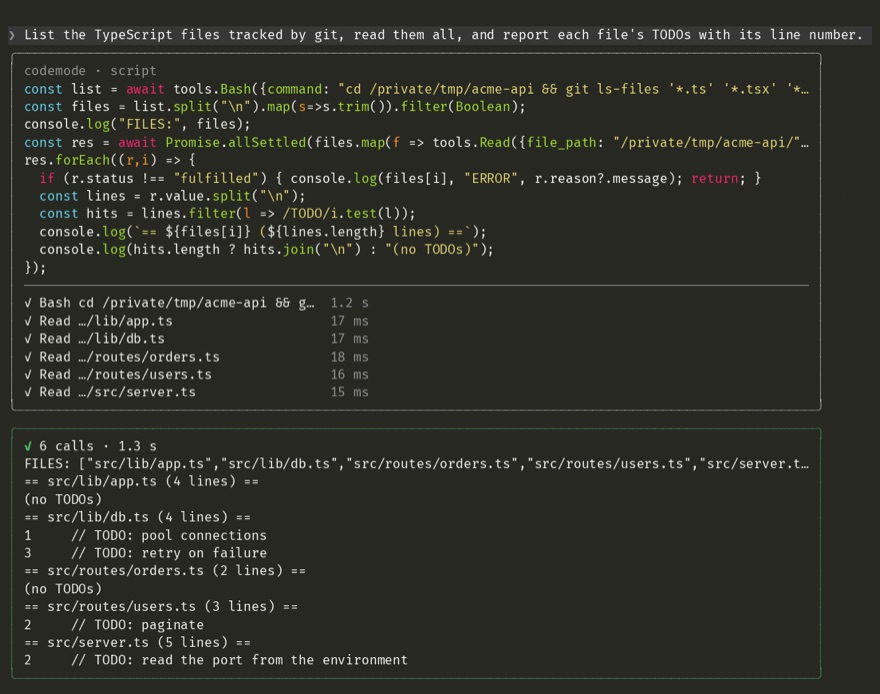
Plate 1 This is the community add-on, not Anthropic’s Code Mode: one small program finds five files, reads them all at once, and only the to-do notes come back. Screenshot from the ejklock/claude-code-mode project (MIT licence), retrieved 25 Nov 2026.25
Plate 1 The community bridge, not native Code Mode: one script lists five files with git, reads them in parallel, and only the TODO lines come back. Screenshot from the ejklock/claude-code-mode repository (MIT), retrieved 25 Nov 2026.25
Plate 1 ejklock/claude-code-mode transcript (the community bridge, not native Code Mode): tools.Bash lists tracked files, Promise.allSettled reads five in parallel, six nested calls in 1.3 s, only TODO lines returned. Repository asset, MIT, retrieved 25 Nov 2026.25
Nine updates in thirteen days
Nine releases in thirteen days
79 changelog entries in nine releases over thirteen days
In the thirteen days after launch, Anthropic shipped nine updates with 79 notes about Code Mode, and 49 of those were fixes. Whatever’s true today could change next week.32
The launch post got 12,700 likes. The most popular replies made fun of the name (“Claude Code Code Mode”), said other tools did it first, and asked for it in more places.33
Between 2.1.323 on 12 November and 2.1.332 on 25 November, nine releases carried 79 changelog entries about Code Mode, 49 of them fixes. Anything here about how it behaves is a snapshot.32
The announcement drew 12.7k likes and 2.56 million views. The most-liked replies mocked the name, said Pi, Cloudflare or DeepSeek got there first, asked for it in the Agent SDK and the Desktop app, and called losing Remote Control a dealbreaker.33
Entries matching “Code Mode” per release: 2.1.323 (12 Nov) 1; 2.1.325 3; 2.1.326 7; 2.1.327 3; 2.1.328 22; 2.1.329 17; 2.1.330 9; 2.1.331 6 (adds Bedrock, Agent Platform, Foundry and Claude Platform on AWS); 2.1.332 (25 Nov) 11. Total 79, of which 49 begin “Fixed”. Behavioural claims on this page are pinned to 2.1.332. The changelog has no 2.1.324 entry, which is why this is nine releases where the Gemini report counts ten.32
Reception, counted 25 Nov: @ClaudeDevs’s post at 12,726 likes and 2,564,563 views. Top replies by likes: “No, thank you.” (358), “Why are frontier labs so uniquely bad at naming things” (153), prior-art claims for Pi, Cloudflare and DeepSeek’s PTC mode, requests for the Agent SDK and Desktop, and “The incompatibility with /RC is a dealbreaker.”33
| Date | Release | Entries | Entries drawn to scale |
|---|---|---|---|
| 12 Nov | 2.1.323 | 1 | |
| 13 Nov | 2.1.325 | 3 | |
| 16 Nov | 2.1.326 | 7 | |
| 17 Nov | 2.1.327 | 3 | |
| 19 Nov | 2.1.328 | 22 | |
| 19 Nov | 2.1.329 | 17 | |
| 20 Nov | 2.1.330 | 9 | |
| 23 Nov | 2.1.331 | 6 | |
| 25 Nov | 2.1.332 | 11 | |
| 9 releases | 79 | 49 of them fixes |
Schedule D Notes about Code Mode in each update, 12 to 25 November 2026. Two updates on 19 November carried 39 of the 79.32
Schedule D Code Mode entries per release, 12 to 25 November 2026. The two releases on 19 November carried 39 of the 79.32
Schedule D Code Mode changelog entries per release, 2.1.323 to 2.1.332; 2.1.328 and 2.1.329, both 19 November, account for 39 of 79.32
When to switch it on
When to turn it on
Conditional verdicts
These are my judgements, built from everything above, not test results. Each says what it rests on, what it gives up, and what would change it. As at 25 November 2026.
These are judgements built from the claims above, so each one names the claims it rests on, what it loses on, and what would change it. As at 25 November 2026, Claude Code 2.1.332.
Every pick below is an inference across the claims it names, not a measurement. Pinned to Claude Code 2.1.332 on 25 November 2026.
Overall
Inferred Switch Code Mode on for big jobs with lots of steps, with rules set for anything you always want to approve. It does best on jobs that fetch lots of records and only need a total or a short list back. On file jobs it’s often slower and saves less money than words, and some other features stop working while it’s on. What would change it: careful tests showing file jobs get reliably cheaper, or Anthropic letting it work through a middle-man.12
Inferred Turn Code Mode on for long jobs with many tool calls, in auto mode, with ask rules on the commands you need to see, and expect the biggest return where the job makes many MCP calls and needs back a total or a short list. On file work the bill falls less than the token count or rises, every file pair in the largest benchmark ran slower, and you give up Remote Control, Claude in Chrome and computer use while it’s on. What would change it: a file-work benchmark showing the cost saving holds, or Anthropic letting it run through a gateway.12
Inferred Enable Code Mode for long multi-call sessions in auto mode, with ask rules on commands you must see and PreToolUse hooks set to "onFailure": "block"; the strongest measured case is MCP chains that return an aggregate. On file work, cost falls by less than tokens or rises and wall time rose in every Bicameral pair, and it disables Remote Control, Claude in Chrome and computer use. What would change it: a five-plus-run file-work benchmark showing cost reduction holding, or provider support for gateways.12
Long jobs with many tool calls
- Inferred Big jobs, first pick: switch it on. Loses on: speed and money on file jobs, where the words saved run well ahead of the money saved.12
- Inferred Long jobs, first pick: turn it on. MCP chains, log digging and multi-file refactors are where the token and turn savings show up, and on MCP chains the bill and the wait fall with them. Loses on: speed and dollars on file work, where the count falls further than the bill. If an MCP router already wraps its servers in a code tool, give the session the plain tools instead.12
- Inferred Long multi-call sessions, pick 1: enable. Rests on c-tokens, c-cost, c-bicameral, c-time, c-scripting, c-background, c-nested (behind a router that fronts servers with a code tool, expose the plain tools instead). Loses on: latency and cost on file work; check aggregates that a script’s filter produced (c-filter).12
- Inferred Big jobs, second pick: leave it off and let Claude write its own program the old way. Loses on: you can’t see what that program changed.2
- Inferred Long jobs, second pick: leave it off and let Claude script the job in the shell. You get much of the batching without the experimental flag. Loses on: edits made by a shell script don’t show in Claude Code’s diffs or file history.2
- Inferred Long multi-call sessions, pick 2: leave it off and accept Bash-run scripts. Rests on c-scripting, c-cost-flat. Loses on: edits outside Claude Code’s tools bypass diffs,
/costline counts and file history.2
Quick questions and one-file edits
- Inferred Small questions: leave it off. Loses on: it’s on or off for a whole session, so a session with both kinds of job has to pick one.34
- Inferred Quick questions and one-file edits: leave it off. The timed losses cluster here, and in the largest benchmark a one-question job cost more with it on, on every model whose costs could be compared. Loses on: Code Mode is per session, so a session that mixes both kinds of work has to pick one.34
- Inferred Short sessions, pick 1: leave it off. Rests on c-small, c-time, c-cost, c-bicameral (C0 recorded cost +27% to +36% on three models), c-startup. Loses on: Code Mode is per session and per resume, so a mixed session has to choose.34
Behind a gateway or local proxy
- Inferred Through a middle-man, first pick: try it in a separate session that connects to Anthropic directly. Loses on: whatever the middle-man was doing for you.56
- Inferred Behind a gateway or local proxy, first pick: trial it in a separate session that connects to Anthropic directly, and run
/statusfirst. Loses on: whatever the proxy adds, such as routing, logging and model switching.56 - Inferred Gateway or custom ANTHROPIC_BASE_URL, pick 1: trial in a separate session connected directly to Anthropic, after reading
/status. Rests on c-proxy, c-local, c-local-why. Loses on: whatever the proxy provides (routing, logging, model switching).56 - Inferred Through a middle-man you have to keep: the community add-on is the only option, and it’s untested and no longer updated.25
- Inferred Behind a proxy that has to stay: the community bridge is the only code mode on offer, at the cost of an unmaintained plugin on an early-access API, untested on current releases.25
- Inferred Gateway that has to stay, pick 2: the ejklock bridge as a mod. Rests on c-ejklock-role. Loses on: unmaintained since 13 October, untested on 2.1.33x, early-access API.25
Unattended runs that can delete things
- Inferred Left running on its own with power to delete things: keep your rules outside the plan, where Claude can’t edit them. Loses on: if you make it ask before every plan, it can’t keep working while you’re away.532
- Inferred Unattended runs with destructive reach: keep the checks outside the script. Ask rules on the commands that matter, PreToolUse hooks with
onFailureset to block, and a container if file and MCP calls must be isolated. Loses on: an ask rule on REPL itself stops background code from running unattended.532 - Inferred Unattended runs with destructive reach, pick 1: keep enforcement outside the script, meaning ask rules on sensitive commands, PreToolUse hooks with
"onFailure": "block", strict sandbox mode, and a container where file and MCP calls must be isolated. Rests on c-classifier, c-outside, c-hooks, c-reviewquote. Loses on: an ask rule on REPL itself blocks unattended background code.532
How this page was made
I asked my research agent, Claude running in Claude Code, to research Code Mode and draft this page; it's published under my name after I read it. Every claim traces to a row in the ledger that ships beside the page as claims.json.
Research panel. Four research backends returned, in two rounds on 25 November 2026. Dossier first started four, with up to US$4.00 reserved, and one returned: Perplexity Sonar Deep Research, 19 citations, all resolving. Gemini's web lane never started, so I ran Gemini Deep Research by hand and read its report in full. For the second round, the OpenAI lane ran on the API instead of a usage-limited subscription: gpt-6.1-sol through the Responses API, up to US$9.00 reserved, 40 citations, all resolving. And the Claude lane ran in this same session through Dossier's free local research loop, after the Claude Code lane refused with a subscription error; it had no working web search, so it reached sources through the GitHub, arXiv and Hacker News APIs, and because it is the session that drafted this page it isn't an independent opinion. Its 17 citations all resolve. The backends split on the main recommendation, and the proxy section sets out where the docs and the binary side with each. The OpenAI lane found the Bicameral benchmark, which I then read at the source and which changed this page's headline.
Read directly. The Code Mode docs page and 16 pages it links to; every changelog entry from 2.1.323 to 2.1.332; the ejklock/claude-code-mode repository at commit 4faec73; the npm registry entry for pi-codemode; InfoQ's 23 November write-up; the Bicameral benchmark's results and measurement files; Arindam Majumder's write-up; the Code Mode bug reports on the claude-code issue tracker; two arXiv preprints on programmatic tool calling; Pi's codemode.md; posts by Flavio Copes, Armin Ronacher and Earendil; 18 YouTube caption tracks found by view count for the past month, of which 15 discuss Code Mode (the other 3 surfaced in search and never mention it, so they're not cited); and X, read post by post in a signed-in browser after the grok CLI returned “402 Payment Required”.
Local reads, 25 November 2026. Claude Code 2.1.332, native build, 383,795,280 bytes, on macOS 27.0 build 26A428, read with strings -n 6; and 4,687 session logs under ~/.claude/projects modified in the previous 14 days, searched for "name":"REPL". Absence in those logs is a fact about one machine, not about anyone else's.
Not established. A cost breakdown by token class; any test above three runs a side (Bicameral's largest benchmark has two per cell); a file-work cost saving that holds; whether the community bridge runs behind a proxy; and the reason /status prints on my machine. Several figures are single-sourced, and each one says so beside it.
Figures. Drawn by hand in SVG from the numbers in the ledger. The two inks were checked with a colour-vision validator: pale and dark marks separate at ΔE 33 under simulated deuteranopia, and both clear 3:1 against the paper in each theme. No 3D: nothing here depends on depth or viewpoint. Motion is GSAP 3.13; nothing is scrubbed or pinned, because nothing in the argument changes with scroll distance, so it draws the schedules, settles the headings, and switches off under reduced motion.
Sources
45 sources, numbered by first appearance. Read 25 November 2026.
- 1 Claude Code “Code Mode” Benchmark (96 runs, six tasks, four models) Bicameral-AI, GitHub · independent benchmark · 2026-11-17Cited in In short, Counted and charged, The clock, When to turn it on
- 2 I Tested Claude Code’s New Code Mode 6 Times Better Stack, YouTube · practitioner video, captions read · 2026-11-20Cited in In short, Counted and charged, What the script changed, When to turn it on
- 3 Claude Code’s Code Mode: Worth It? Software Engineer Meets AI, YouTube · practitioner video, captions read · 2026-11-19Cited in In short, Counted and charged, The clock, When to turn it on
- 4 I benchmarked Claude Code’s Code Mode: 8 interactive runs, 2 tasks George (@bolyki) on X · practitioner benchmark · 2026-11-18Cited in In short, Counted and charged, The clock, When to turn it on
- 5 Run tool calls from code with Code Mode Anthropic, Claude Code docs · official documentation · read 2026-11-25Cited in In short, The borrowed numbers, The clock, What the script changed, The safety check, The proxy, Other code modes, When to turn it on
- 6 Claude Code 2.1.332 binary, strings read locally this page’s author · local artifact read · 2026-11-25Cited in In short, The proxy, Other code modes, When to turn it on
- 7 Claude Code’s New Code Mode Clearly Explained (it’s cheaper) Nate Herk, YouTube · practitioner video, captions read · 2026-11-24Cited in In short, Counted and charged, The clock
- 8 Claude Code : 77 % de tokens en moins avec Code Mode ? Pentiminax, YouTube · practitioner video, French captions machine-translated · 2026-11-23Cited in In short, Counted and charged
- 9 Timed runs I could find for Code Mode, on vs off Nhan Tran (@nhantrandev96) on X · compilation of practitioner runs · 2026-11-23Cited in In short, The clock
- 10 4,687 local Claude Code session logs, 11–25 Nov 2026 this page’s author · local artifact read · 2026-11-25Cited in In short, The proxy
- 11 Code execution with MCP: building more efficient agents Anthropic Engineering · vendor engineering post · 2025-11Cited in The borrowed numbers, Other code modes
- 12 Code Mode: the better way to use MCP Cloudflare · vendor engineering post · 2025-09Cited in The borrowed numbers, Other code modes
- 13 Code Mode benchmarks Bifrost docs · vendor benchmark · undated, read via Dossier 2026-11-25Cited in The borrowed numbers
- 14 Claude Code Just Dropped Code Mode (Master it in 7 Minutes) Duncan Rogoff, YouTube · practitioner video, captions read · 2026-11-24Cited in The borrowed numbers
- 15 Three different 37% numbers attached to Code Mode Nhan Tran (@nhantrandev96) on X · compilation of practitioner runs · 2026-11-17 and 2026-11-23Cited in The borrowed numbers, Counted and charged
- 16 Beyond Plain MCP: Do Decision Models and Code Mode Make Tool Use Cheaper and Faster? Abhishek Rai, arXiv 2611.19123 (preprint) · preprint · 2026-11-14Cited in The borrowed numbers
- 17 The Bitter Lesson of Tool Calling Ishan Patel, Sahil Sen, Elias Lumer et al., arXiv 2608.06370 (preprint) · preprint · 2026-08-06Cited in The borrowed numbers
- 18 Code Mode can improve both speed and context efficiency Addy Osmani on X · post · 2026-11-21Cited in The borrowed numbers
- 19 code mode is just a different way of doing tool calling @trq212 on X · remark by an Anthropic engineer, before launch · 2026-10-17Cited in The borrowed numbers
- 20 Claude Code Adds Experimental Code Mode to Orchestrate Tools Daniel Dominguez, InfoQ · engineering journalism · 2026-11-23Cited in Counted and charged, The safety check
- 21 This Experimental Feature Is Claude Code’s BIGGEST Upgrade of 2026 Chase AI, YouTube · practitioner video, captions read · 2026-11-19Cited in Counted and charged, The clock
- 22 Code Mode Makes Claude Code Smarter & Cheaper Ray Amjad, YouTube · practitioner video, captions read · 2026-11-17Cited in Counted and charged, Other code modes
- 23 Code Mode on and off with the same prompts Andres (@AndresMuelasT) on X · practitioner benchmark · 2026-11-19Cited in Counted and charged
- 24 How Claude Code’s Code Mode works Arindam Majumder · practitioner write-up with a paired run · 2026-11-21Cited in Counted and charged
- 25 claude-code-mode: a bridge to Pi’s code mode Evaldo Klock (ejklock) on GitHub · open-source repository with author benchmarks · 2026-10-06 to 2026-10-13, v0.7.3Cited in Counted and charged, Other code modes, When to turn it on
- 26 Architectural Evaluation of Claude Code Native Code Mode (Gemini Deep Research) Gemini Deep Research, run by hand in the browser after the Dossier lane failed to start · research backend output · 2026-11-25Cited in Counted and charged, The proxy, Other code modes
- 27 Claude Code Finally Got MCP Code Mode (Setup + Test) JeredBlu, YouTube · practitioner video, captions read · 2026-11-16Cited in Counted and charged, The clock
- 28 smol models aren’t great at codemode at all yet. frontier models love it. Mario Zechner (@badlogicgames) on X · practitioner remark, Pi author · 2026-10-17Cited in Counted and charged
- 29 How to use Code Mode in Claude Code Flavio Copes · practitioner test, single runs · 2026-11Cited in The clock, What the script changed
- 30 Code Mode: steps chained after a background shell command never run (#111618) anthropics/claude-code issue tracker · user bug report · 2026-11-22Cited in The clock
- 31 Code Mode: Claude waits for long CI runs with sleep() and poll loops in REPL scripts (#112152) anthropics/claude-code issue tracker · user bug report · 2026-11-25Cited in The clock
- 32 Claude Code changelog, 2.1.323 to 2.1.332 Anthropic · official release notes · 12–25 Nov 2026Cited in What the script changed, The safety check, The proxy, Thirteen days, When to turn it on
- 33 Code Mode announcement and its replies @ClaudeDevs on X · official post; replies are opinion · 2026-11-17Cited in What the script changed, The safety check, Thirteen days
- 34 Permission modes: auto mode decision order Anthropic, Claude Code docs · official documentation · read 2026-11-25Cited in The safety check
- 35 How Code Mode is implemented in Claude Code Rhys Sullivan (@RhysSullivan) on X · practitioner observation · 2026-11-15Cited in The safety check, Other code modes
- 36 Code Mode: hooks can’t see inner tool calls, and file().text() skips Read events (#111575) anthropics/claude-code issue tracker · user bug report · 2026-11-21Cited in The safety check
- 37 PostToolUse updatedToolOutput keeps only ~30,000 characters and drops the spill path (#112065) anthropics/claude-code issue tracker · user bug report · 2026-11-24Cited in The safety check
- 38 Code Mode: hooks modules never get classic.PostToolUse for REPL output (#111259) anthropics/claude-code issue tracker · user bug report · 2026-11-20Cited in The safety check
- 39 Dossier panel member report (Perplexity Sonar Deep Research) Dossier run dr_79c2b59543276ae4 · research backend output · 2026-11-25Cited in The proxy
- 40 Dossier panel member report (OpenAI gpt-6.1-sol, Responses API) Dossier run dr_64065e4168fefefb · research backend output · 2026-11-25Cited in The proxy
- 41 Dossier panel member report (Claude, run in-session through the local research loop) Dossier run dr_0ebb0a242046ba6f · research backend output · 2026-11-25Cited in The proxy
- 42 Codemode (pi coding agent docs) Earendil · official documentation of another harness · read 2026-11-25Cited in Other code modes
- 43 You Said No MCP! Earendil Engineering · vendor post · 2026-09-29Cited in Other code modes
- 44 What is Codemode Armin Ronacher · practitioner essay · 2026-10-06Cited in Other code modes
- 45 @earendil-works/pi-codemode on npm npm registry · package registry · read 2026-11-25 (latest 1.6.0, modified 2026-11-20)Cited in Other code modes